I have just published my first online class on SkillShare, called "Abstract Collage: Creating Compositions with Tissue Paper". Take a look here, and get two months of access to all of SkillShare's video tutorials free. Following the SkillShare format, the class contains ten short video lessons in 43 minutes. You can post your work on the site, ask questions, see other's work, etc.
I take you through the process of painting/staining tissue paper, cutting out the shapes, and playing with arrangement, all in the service of exploring abstract composition. Check it out! And let me know what you think. This is a new platform for me for teaching, though I have been a member of Skillshare as a learner for over a year.
Monday, June 8, 2020
Monday, June 1, 2020
Practicing Art - A Conversation
I posted a photo of my mini-collages on Instagram @janedaviesart and got an interesting question:
I invited an e-mail conversation so that I could address this question that many artists have: if it isn't practical or doesn't make a salable piece, what is its value?
Here are some of the mini-collages:
Q: My main question was if you had a purpose in mind when you created these simplified works, if you save them, and how you view the time spent creating them. Are you working towards a goal or just doing them for relaxation?
A: When I need a break from whatever larger work I’m doing, OR when I’ve been out of the studio for a while and am rusty, the best way to get ideas moving is to keep my hands and eyes DOING something in the studio. Not thinking, but doing. And that takes on many forms. This little exercise I just made up and did a LOT of them. The main point is to do SOMETHING with hands and eyes to generate ideas, see where it goes, keep in practice, jog something loose, get back to some basic ideas, etc. It is not for relaxation, though it might be relaxing.
Q: I tend to feel guilty if I spend a lot of time and money on materials with art ‘just for fun and relaxation’ vs. a finished piece. I could make dozens of simpler works, but I’m not sure what I’d do with them except throw them in the trash eventually! My Inner Critic tells me that it’s silly to waste time just doing things for the fun in the moment and then throwing them away, since there is no practical use for them.
A: Yeah. I hear you. And probably so does every other artist, especially women. 'Be Useful, Be Practical, Be Thrifty or you are wasting time, wasting space, wasting money', etc. is a strong inner voice in our culture. It reveals our own lack of confidence in the value of our work, and in the value of art generally. In my view, the value has to start with YOU, the artist, not someone else putting a price on it or putting it to practical use. This shift in attitude takes years and constant vigilance. When there is stuff To Be Done (practical), and I am in my studio making useless little collages, my belief in their value has to be stronger than the voice saying I Should Weed The Garden.
Is there a purpose to making these and saving them? I’m asking because I tend to purge art that is not created for display. I have mixed feelings because I enjoy the creative process, but it’s not really a piece of art, per se.
I invited an e-mail conversation so that I could address this question that many artists have: if it isn't practical or doesn't make a salable piece, what is its value?
Here are some of the mini-collages:
Q: My main question was if you had a purpose in mind when you created these simplified works, if you save them, and how you view the time spent creating them. Are you working towards a goal or just doing them for relaxation?
A: When I need a break from whatever larger work I’m doing, OR when I’ve been out of the studio for a while and am rusty, the best way to get ideas moving is to keep my hands and eyes DOING something in the studio. Not thinking, but doing. And that takes on many forms. This little exercise I just made up and did a LOT of them. The main point is to do SOMETHING with hands and eyes to generate ideas, see where it goes, keep in practice, jog something loose, get back to some basic ideas, etc. It is not for relaxation, though it might be relaxing.
Q: I tend to feel guilty if I spend a lot of time and money on materials with art ‘just for fun and relaxation’ vs. a finished piece. I could make dozens of simpler works, but I’m not sure what I’d do with them except throw them in the trash eventually! My Inner Critic tells me that it’s silly to waste time just doing things for the fun in the moment and then throwing them away, since there is no practical use for them.
A: Yeah. I hear you. And probably so does every other artist, especially women. 'Be Useful, Be Practical, Be Thrifty or you are wasting time, wasting space, wasting money', etc. is a strong inner voice in our culture. It reveals our own lack of confidence in the value of our work, and in the value of art generally. In my view, the value has to start with YOU, the artist, not someone else putting a price on it or putting it to practical use. This shift in attitude takes years and constant vigilance. When there is stuff To Be Done (practical), and I am in my studio making useless little collages, my belief in their value has to be stronger than the voice saying I Should Weed The Garden.
I can not make good, real, art that is truly mine unless I constantly explore, constantly make and observe, and allow myself the space-time-money to make work that does not see the light of day.
To tell you the truth I do not know what will become of my little collages, and that is the furthest thing from my mind as I am creating them. It’s paint, paper, matte medium (for the glue), a little time, a little process-focus. To me the value is in doing it and “keeping in shape” as an artist.
Q: I’d love to hear your take on it; why you create so many simple, practice works, with good materials. What is the purpose, what do you do with them, etc., so that I can stop feeling guilty when I “play” and spend time lots of time just for the sake of enjoying my materials, and the end product has no real purpose other than the joy of creating in the moment, unworthy of sharing as a piece of art.
A: I don’t think of them as ‘practice works’. Doing them is just part of Doing The Work as an artist. I recommend to my students to keep the focus on process and on developing and maintaining a HEALTHY ART PRACTICE. The good, genuine pieces of art, art that is yours, is a byproduct of your healthy art practice. Let it show up on its own, don’t force it.
Thursday, May 21, 2020
Stripes Morph into Grids
I am still working, slowly, on my Stripes, but I started some smaller works that are becoming grids. They are very much inspired by the Quilts of Gee's Bend, in particular, the ones made from work clothes. I want faded, neutralized colors, like the worn out clothing that is given a new life in a handmade quilt.
I started by painting the center of the 9x12" bristol substrate in a kind of variegated neutral, and then started adding collage bits and some paint to the border. Not sure where this is going.
![]() |
| This is an example of the beginning, in this new series. |
![]() |
| Beginning to add collage around the edge. I love the wonky stripes of gray on gray. |
![]() |
| This is another one at Stage 2. I want to use minimal color, and emphasize the subtleties in the neutrals. |
![]() |
| Still in progress |
![]() |
| This one is resting. |
![]() |
| This and the next one are a little more colorful. I like the wonky edge around the neutral center. Maybe I'll play with that a little. |
Monday, May 11, 2020
Stripes as Meditations on Color
Here are a few of the stripe pieces I've been working on. The ones pictured below are all 11"x14", acrylic and collage on paper. There are larger ones in the works as well, which I'll post at some point.
Since all of my spring workshops have been cancelled, and the non-profit I'm part of, the Rupert Village Trust, has suspended activities for the time being, I've had more time in my studio. Though I am teaching online, I am not traveling, and I find the longer stretches of time in my studio have allowed me to relax into a narrower and deeper focus than is typical.
How has the pandemic affected your art practice? Are you more distracted? More focused? Do you have more time or less time to make art?
These stripes and others are available as prints and products on Pixels/FineArtAmerica.
![]() |
| 1 |
![]() |
| 2 |
![]() |
| 3 |
![]() |
| 4 |
![]() |
| 5 |
![]() |
| 6 |
How has the pandemic affected your art practice? Are you more distracted? More focused? Do you have more time or less time to make art?
These stripes and others are available as prints and products on Pixels/FineArtAmerica.
Friday, April 24, 2020
Stripes to Cheer Up a Room
This is a super easy project I'm offering, as a way to relax and make something cheery (or calming) for your home or whatever personal space you are occupying. We are Painting Stripes on a Paper Bag using materials that you may already have around the house. In the video I use craft paints, one color of Liquitex Basics, and a few NovaColor paints. You can use all craft paints, or even leftover colors of interior latex house paint. I prime the paper bag with interior latex.
Use whatever you have for brushes - even sponge brushes or cheap hardware store brushes will work. I uses these Dynasty Brushes from Blick.
A couple of the craft paints I use are Blick Matte Acrylics, which are very opaque. They are a little more expensive than DecoArt - type craft paints, but still very affordable. I suggest you make a few of these, and tape or tack them to the walls.
If you prefer an easier, but more expensive, way to introduce stripes into your home, go to my Pixels/Fine Art America site and buy a print or product with stripes.
The nice thing about prints is that you can get them much larger than the original paintings.
Use whatever you have for brushes - even sponge brushes or cheap hardware store brushes will work. I uses these Dynasty Brushes from Blick.
A couple of the craft paints I use are Blick Matte Acrylics, which are very opaque. They are a little more expensive than DecoArt - type craft paints, but still very affordable. I suggest you make a few of these, and tape or tack them to the walls.
The nice thing about prints is that you can get them much larger than the original paintings.
Wednesday, April 8, 2020
A Timely Mandala from the De-Stress Class
Here is a post from a participant in my De-Stress class.
She says:
She says:
"As a Microbiologist, I couldn’t resist the urge to make something very timely. On the left is my version of the CORONAVIRUS. On the right, we’ll call that one INFLUENZA!"
Tuesday, April 7, 2020
Mandalas from the De-Stress Workshop
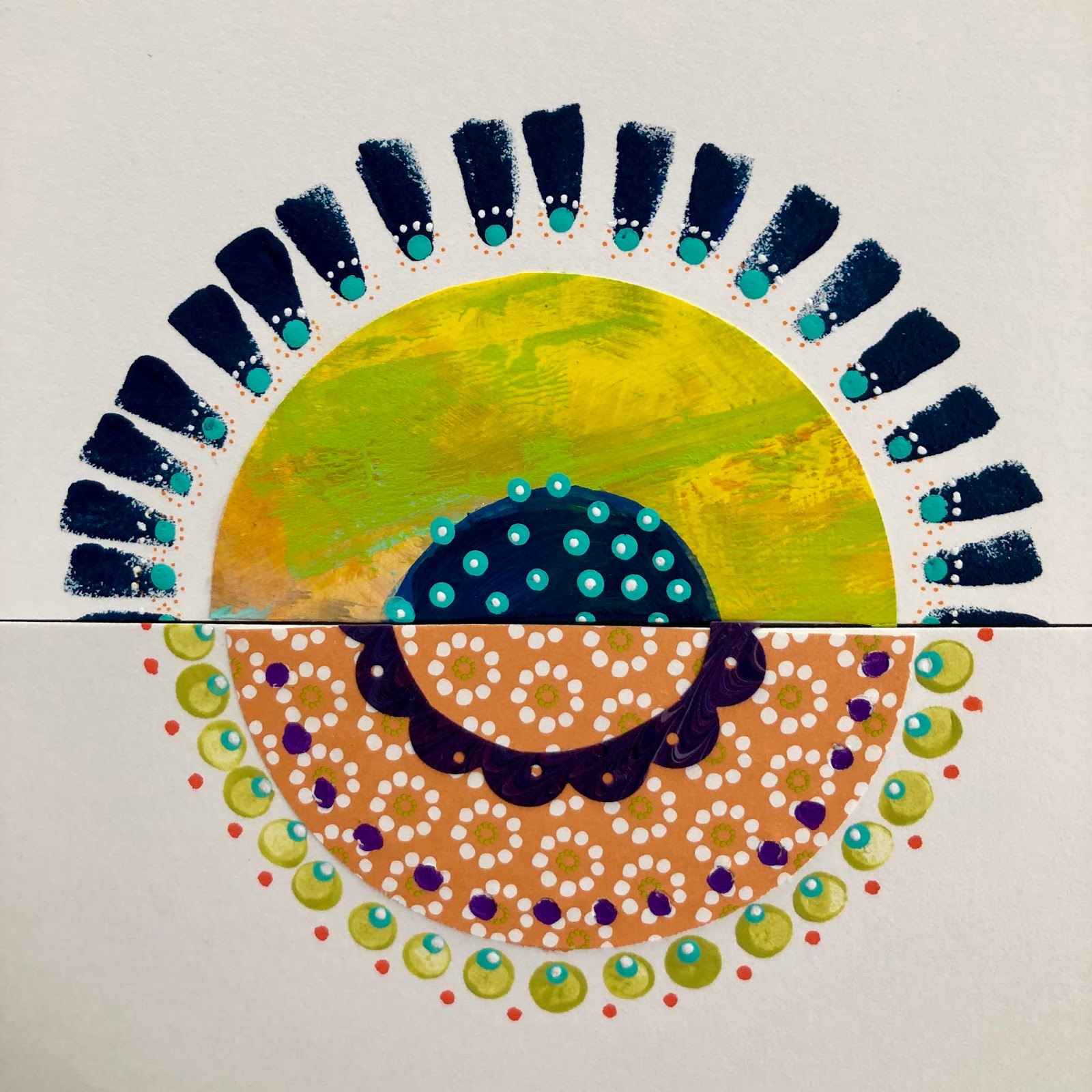
Here are a few, a very few, of the mandalas that participants in my De-Stress with Art workshop shared on our group blog. This is the tip of the iceberg, as it were. SO fun to see all the gorgeous pieces. The project is to make half-mandalas and then play with different combinations.
Enjoy! Thanks for visiting.
![]() |
| Check out the fish in this one. |
Enjoy! Thanks for visiting.
Sunday, April 5, 2020
Make your own Envelopes!
With Lucie Duclos. Lucie just released a new class on SkillShare, which you can find HERE. In it she shows you how to make your own envelope glue, which you can also use on collage papers. Just apply to the back, then after it's dry you can cut and stick collage papers to a surface by licking the pieces as you would a postage stamp. Great for teeny tiny collage pieces. Here are a couple of images from Lucie:
Find the class on SkillShare here: https://skl.sh/2V8okCC
I am working on a class for SkillShare that is an introduction to abstract composition using tissue paper collage. I will keep you posted on its release date.
Find the class on SkillShare here: https://skl.sh/2V8okCC
I am working on a class for SkillShare that is an introduction to abstract composition using tissue paper collage. I will keep you posted on its release date.
Saturday, March 21, 2020
Sheltering In Place
For those of you who may have some extra time on your hands and could use a little bit of online creative community, I have created a new online workshop called "De-Stress with Art". It is a series of five projects that are designed to help you relax and focus while making beautiful images. You can see the full description here, and sign up if you like.
We'll start with mandalas, as they are soothing to create, and yet they offer a lot of creative possibility. Actually, we make half mandalas, so that we can put them together in unexpected ways.
My inclination was to offer something for free, but at the same time many of my workshops are being cancelled, so my own income for this year is pretty uncertain. My compromise is to offer this class for $100, considerably less than my other online classes. All my YouTube videos are free, so please use those as a resource for your creative endeavors.
Stay healthy! If you can, enjoy the change of pace, though I'm sure that is not possible or easy for many
We'll start with mandalas, as they are soothing to create, and yet they offer a lot of creative possibility. Actually, we make half mandalas, so that we can put them together in unexpected ways.
My inclination was to offer something for free, but at the same time many of my workshops are being cancelled, so my own income for this year is pretty uncertain. My compromise is to offer this class for $100, considerably less than my other online classes. All my YouTube videos are free, so please use those as a resource for your creative endeavors.
Stay healthy! If you can, enjoy the change of pace, though I'm sure that is not possible or easy for many
Friday, March 13, 2020
The Visual Sentence
I have been experimenting with a process of assembling prints (from the gel plate and foam relief plates) into pieces, which reminds me of stringing words together to make sentences. Each print has a few elements - they are not just all-over patterns - and combining them offers a fresh approach to 'composing'. I learned this process from Joyce Silverstone at North Country Studio Workshops last January. See my post about it here. Whereas in a collage, your substrate determines the boundaries of the piece, in 'scrolling' (Joyce's term for the process), you assemble the parts without a substrate and make up the boundaries as you go along.
Above are a few pieces that I assembled visually, and then scanned the parts and put them together digitally. These are available as prints and products on Pixels/Fine Art America.
I will be teaching "The Visual Sentence" later this year in Montreal, and next year at Hudson River Valley Art Workshops. Stay tuned to my calendar.
Wednesday, March 4, 2020
Making hearts is a way to engage in painting or collage without taking it too seriously. How can you agonize over your image when it is the most over-used, cliché of clichés in the realm of shapes?
For this reason I am offering a workshop on mixed media techniques in which we use the heart as the image. It is called Light Hearted, and I'll be offering it along with other workshops at Art and Soul this May in Colorado Springs. Read about it here. See my other workshop here.
In the video I am using Utrecht acrylic matte medium to adhere the collage to the substrate, and also for the top coat. It is my favorite matte medium for collage. The markers are Posca, which are opaque paint markers.
These and other 'light hearted' images are available as prints or on products through Pixels/Fine Art America. Click here for prints and products.
For this reason I am offering a workshop on mixed media techniques in which we use the heart as the image. It is called Light Hearted, and I'll be offering it along with other workshops at Art and Soul this May in Colorado Springs. Read about it here. See my other workshop here.
In the video I am using Utrecht acrylic matte medium to adhere the collage to the substrate, and also for the top coat. It is my favorite matte medium for collage. The markers are Posca, which are opaque paint markers.
Wednesday, February 19, 2020
Staining Tissue Paper to use in Collage
Here is a video I just released demonstrating how to make stained tissue paper in small quantities. In 2011 I did a post about staining tissue papers in much larger quantity, taking up a lot of space to make full sheets. Read it here and find some useful links. This video shows a more compact version.
You need palette paper (or use freezer paper); white tissue paper (I use Blick); fluid acrylic paints - transparent colors give you the best results; water, brushes.... I think that's it.
I used the resulting material in the collages above. These are very simple studies in which I am focusing on scale, value, and arrangement of elements.
You need palette paper (or use freezer paper); white tissue paper (I use Blick); fluid acrylic paints - transparent colors give you the best results; water, brushes.... I think that's it.
![]() |
| Stone Stack #6, 9x12" |
![]() |
| Stone Stack #7, 9x12" |
![]() |
| Stone Stack #8, 9x12" |
![]() |
| Stone Stack #9, 9x12" |
I used the resulting material in the collages above. These are very simple studies in which I am focusing on scale, value, and arrangement of elements.
You can find the pieces available as prints or products here.
Labels:
arrangement,
composition,
scale,
stained papers,
tissue paper,
value,
video
Subscribe to:
Posts (Atom)