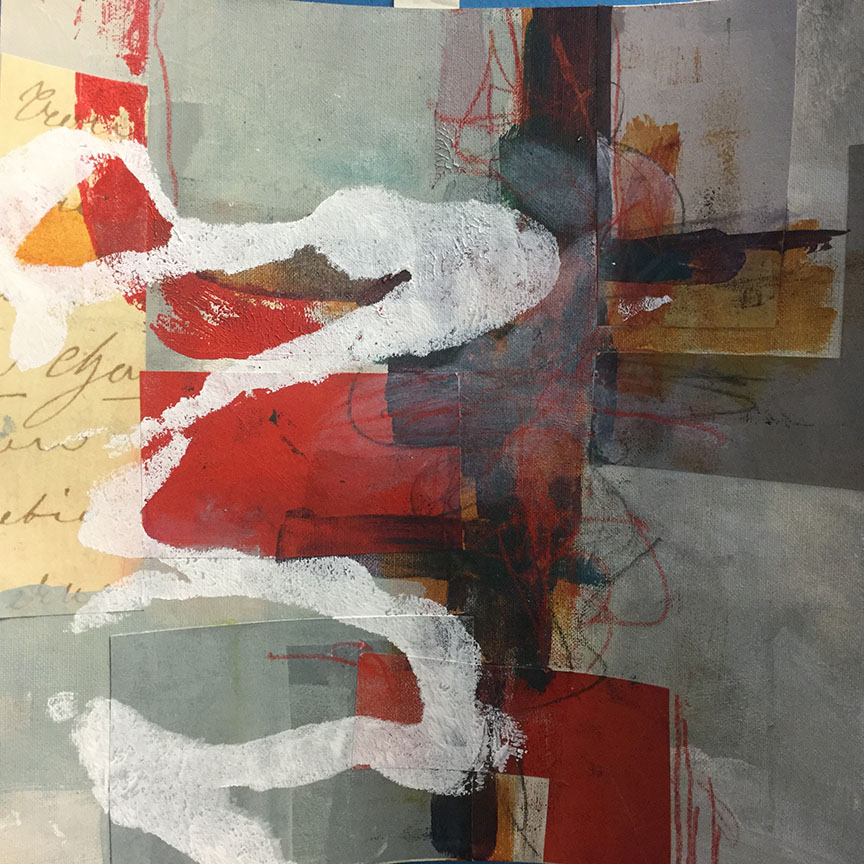
Finally, I've finished my new series of videos on making collage papers. Here is a preview:
Stowe October, 9x12
What Else? 10x10
White Dots 9x12
Pink Collage 9x12
In this series of sixteen videos you will learn a whole new vocabulary of techniques for creating your own collage papers, including making your own stamps and stencils, spattering and dripping High Flow paint, staining tissue paper, altering printed text, using oil pastel, and much more.
Making collage papers that are uniquely yours is a great way to engage with your materials, explore pattern, and discover new color combinations. Each video is all new, original, material. All the techniques are accessible to beginners through advanced painters.
What are your biggest challenges in your art practice?
When looking for a workshop to take, what are your highest priorities?
What are the main things you want to get out of a workshop?
I am always thinking about possibilities for new workshop topics or formats, and your input would be super helpful. Are there particular topics you would like me to address in an online workshop? As downloadable content? Or in a live workshop?
How about a live workshop preceded by an online forum? That is, about a month before a scheduled in-person workshop, everyone who is signed up gets together in an online forum to share work, meet and greet, and do some preliminary "assignments" or projects to prepare for the live workshop.
Let me know your thoughts and suggestions. What have you been doing in your studio lately?
Here is a sampling of student work from my "Series as Process" workshop at Leading Edge Art Workshops in Calgary. What a great city this is! All within easy walking distance of the workshop are loads of excellent restaurants and cafés, a great yoga studio, the Esker Foundation, a terrific book store called Fair's Fair , and lots of parks and paths along the rivers.
The assignment is to work with a combination of neutral colors and bright colors in a grid format. The first is one of my examples, the rest is student work.
My example, 10"x10"
All work is on paper, with dimensions between 8" and 12". Thanks for visiting!
As you may know, I am involved in a project to make an old general store into a community center and café in my little town of Rupert, Vermont. We have formed the non-profit Rupert Village Trust to make this project happen, and while we work on our big-picture fundraising plan, we are doing a small fundraiser to help defray our immediate costs through GoFundMe.
Meanwhile, here is a quick video on mixing greens and turquoises. I just love playing with colors and extracting a big huge palette of subtle variations on a couple of analogous colors. Check it out.
There are a few spots available in my Intro to Intuitive Painting at the Omega Institute the weekend of September 14 - 16. If you've never painted before, or want to refresh your practice, this workshop will get you into your materials and process without the pressure of making "good art". We will draw with a pipe cleaner, color with crayons, paint with our hands, collage with pretty papers, create patterns, make monoprints, and generally PLAY with the art materials in a safe and supportive environment. Sign up here.
I am working on a series of videos that demonstrate various ways to make your own collage paper. This has been such a long-standing interest of mine, as you may know from my DVD that came out in 2012. These are all new videos, and I hope to make them available for download sometime in September. Here is a little preview:
SUCH a fun way to experiment with gel plate techniques! Printing on envelopes is fun, not precious, and gives you the opportunity to send your art pieces out into the world. This video features (and was inspired by) the song "Checks and Love Letters", by Bernice Lewis. Lucie Duclos, in Victoria, BC, is the one opening the mail, gushing over the collage papers I sent.
I am working on a short video demo of gel printing on envelopes, and here is a little preview. The music, Checks and Love Letters by Bernice Lewis, is used by permission.
The last few days I've been trying to get back into a groove of painting. With studio construction back underway and various other projects I'm working on, painting has taken a lower position on my priority list. Building momentum always takes time, and can be frustrating. I flailed around for a while, and then decided to go back to something that feels reasonably comfortable.
As a workshop assignment I often do my Complementary Colors exercise. Here are a couple of examples, which are 10"x10":
Achieving as much variety as I can within one color is a great exercise, and it helps me focus. So I decided to play with orange on top of "works in progress" (which means works that have been hanging around, unfinished, for a while and need an injection of drama). The following pieces are 20"x20" on panel:
Working in black and white gives you the opportunity to focus on value relationships, depth, quality of line, edge, scale, arrangement of elements, and other elements and concepts that sometimes get neglected when color is front and center.
It's summer here in the northern hemisphere, and time to kick back a little, take things a bit slower or easier (anyone who knows me is going to roll their eyes at this - yeah right!). For me it's more challenging in the summer to delve deep into a series of paintings, because I get interrupted and distracted easily. Neighbors stop by, I have construction going on, gardening, more bike rides because of the longer days. So I put together a little kit of art materials that you can pick up for quick, easy, fun art. Art Lite. In Small Bites.
A page spread in my little sketchbook, using most of the materials in my Portable Art Studio
You can put together whatever materials you are comfortable working with, just as long as they don't include acrylic paints and mediums, which require some set-up and clean-up. The Portable Art Studio features materials that are easy and convenient. You can probably put together a kit from things you already have in your studio. Here are my picks:
A small set of pan watercolors such as Sakura Koi Watercolors
A small set of water soluble crayons, such as Caran d'Ache NeoColor II Water brushes
Small scissors and a glue stick (any type)
A small-ish sketchbook paper that will take watermedia
Card Stock: this works great as an inexpensive substrate for small collage. Get it at any office supply store.
Some paint markers. My favorites are Posca Markers in a couple of sizes Micron Pens or other fine permanent felt tip pens (not Sharpies)
A good selection of collage papers in a variety of colors and patterns. Include found text, your own painted papers, decorative papers, maps, junk mail, etc. Variety is key.