Showing posts with label beginner. Show all posts

Tuesday, April 19, 2022

Jane's Art Basics - How To Start A Painting?

 Do you get stuck at the blank canvas? Do you want to paint but don't know how to start? As your art practice evolves you will develop your own go-to strategies for beginning, but if you are new at painting, here are a few suggestions.

  • Don't start a painting. Start multiple paintings. 
  • Do start with an inexpensive, low-stakes, substrate such as Bristol or 80# Cheap Drawing Paper
  • Do focus on the practice, the process, not the 'finished' painting.
  • Don't try to finish a painting. 
  • Do give yourself a time limit if that helps. 

Here is a video on The Five Minute Painting (this is an old one, not great quality):


A group of 9"x12" five-minute paintings


I made these 9"x12" five-minute in one session, which was a total of one hour.

Be assured that there are infinite ways to start a painting, so you can't find the correct way, nor can you start the wrong way, in terms of the first marks you make on the painting surface. You can start with an attitude that will facilitate beginnings. 

Your measure of success is: you showed up and applied paint (or collage or drawing) to a surface. You made marks on a substrate. That's IT. Omit the habitual evaluation and self-criticism. Just leave it out; it is totally irrelevant to this part of a painting practice. 

Let the painting practice be an ongoing inquiry, not a production line. You are discovering what the paint can do, what is in you, who you are as a maker of images. It is a long, slow, ongoing process. A practice. If you set your expectations accordingly it can be extremely engaging and fulfilling. If you begin with the expectation that you will Learn How To Do It Correctly, it can be very frustrating. You will make good paintings - your paintings - when you make a lot of paintings, with attention and focus on process, and with curiosity. Enjoy!

Cat Bennett has several books that are encouraging and helpful for making art as a practice. There are many other books and resources on practicing art, but the real learning is in doing the work. Get the paper out, put some paint on it, pay attention, repeat.

Wednesday, March 16, 2022

Jane's Art Basics: Acrylic Paint Quality

Use the Paints That Work for You

If you are a beginner, you may well get conflicting advice on what kind of paint to buy. Many feel that starting with the highest quality paints you can afford is necessary to have success as a beginner. If you are beginning with a teacher who requires specific, high quality, paints, then that makes sense. 

If you are starting without a teacher, your choice of paint will depend on what your goals are. Do you want to explore image-making as a way to express yourself, or just to relax and do something that takes you out of your everyday life activities? Or do you want to learn, step-by-step, how to make a certain type of painting? Is it a casual interest or a commitment to mastering something specific?

If you want to do art to relax, explore, discover what is in you as an image-maker.... my recommendation is to begin with fairly affordable paints so that you can freely experiment without worrying about 'wasting' expensive material. If high quality paint is going to intimidate you, leave it out. For now.

Once you are  comfortable with a few techniques, and you are committed to your practice, I HIGHLY recommend introducing professional quality paints, such as Golden Fluid Acrylics or Heavy Body Acrylics from Golden, Holbein, Sennelier, or other manufacturers. Start with just a couple of colors that you use a lot, or primary colors - blue, red, and yellow - that you can mix into other colors. Then add more as you grow into your commitment to painting. You will likely extend them with acrylic mediums, as they are very pigment-rich. A little goes a long way.

High Quality Professional Grade Paints

Golden Fluid Acrylics are super easy to use, and come in a huge range of colors. They are professional quality paints, with heavy pigment load, so you can extend/dilute them with any acrylic medium and still get vibrant colors. Other manufactures of high quality paint include Holbein, Sennelier, Kroma, Tri-Art, and many others.

Student Grade Paints

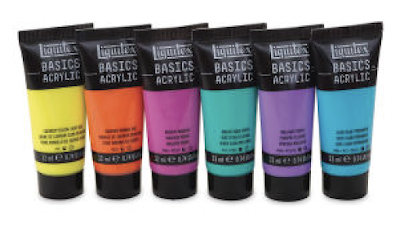
Liquitex Basics are one of several brands of student grade, affordable, paints, that may be a good choice for a beginner. They come in sets, and are very affordable.


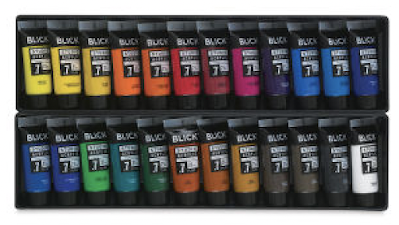
Blick Studio Acrylics are similar to Liquitex Basics. They are affordable, and come in a wide variety of colors.

Arteza offers a few lines of acrylic paints. The "premium" are a decent student-grade paint. There is not a lot of information on the packaging, so it's not clear how light-fast or permanent the colors are. Still, if you are just beginning, these aspects of paint may not be your highest priority. 


Ultimately, if you are committed to a painting practice, you will want to explore the range of qualities of paints. You will find the variety of paints that work for you. I hope this gives you some guidelines.

Monday, February 7, 2022

Art Basics - Playing with Arylic Paints in a Sketchbook

In an attempt to reach out to beginner painters, I've been exploring student-grade paints. Some teachers highly recommend that the beginner start with the best of paints, such as Golden. And that probably is good advice for some. However, I have seen many people afraid to explore freely because of the cost of the material. It's easy to feel intimidated by high quality paint, as if your image must be worthy of such fine material. 


I feel it's important to get the paint that suits you and your budget. If an expensive set of high quality paints is going to sit on the shelf untouched because of fear, then get something more affordable. Student grade paints do not have the same pigment load as professional paints. That is a given. They also have different consistencies, brand to brand. The only way to really know what is right for you is to try a few different brands and qualities of paint.

My advice to beginner painters who are not ready to spring for high-quality paints is this: start with a set of student grade paints (not craft paints), and gradually add your professional quality paints (Golden being my preferred, Holbein, Sennelier are some I've used as well) as needed. One tube or bottle at a time. grow into your good paints as your art practice develops.

Supplies I am using in this video are:

Strathmore sketchbook, hardbound, spiral bound. You can see some commentary on sketchbook options in this video.

Blick Matte Acrylic White, Galeria Acrylic Paint, Liquitex Basics, Arteza premium acrylic paint, 

Disposable Palette

Palette Knife; I like this square-ended one, but I suggest you try a few different shapes. Mine is the small #7, Liquitex Freestyle Painting Knife.

Your eyes and your hands are your most important tools. Enjoy!!

Wednesday, January 5, 2022

Art Basics: Your Supplies

 Here is a video showing you the supplies I recommend for someone just starting out in art. You can see a list of my recommendations, and links, in my previous post.

Thanks for watching, and enjoy your art practice! Happy new Year.

Just to be clear: as you grow into your art practice you will want higher quality paints. Add them gradually as your budget allows. As many of you know, my preferred brand is Golden - they create paints in a range of formats and viscosities (heavy body, fluid, high flow, etc) and a huge variety of mediums and grounds. There are many other high-quality, pigment-rich paints available, too. But to begin an art practice, the less-expensive student-grade paints are a good choice.

Friday, December 31, 2021

Supply List For Beginners

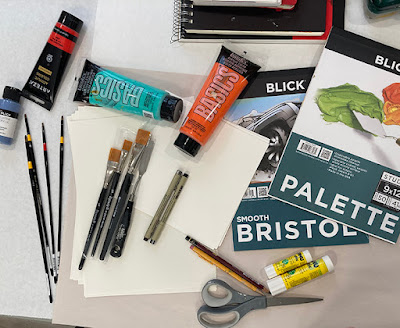
I have been asked a few times what supplies I would suggest for a person just beginning their art practice. So I put together this list of recommendations for those interested in working with acrylic paint, collage, and drawing materials. Download the list here.

My general advice on art supplies: start with basics - paint, brushes, paper, drawing tools - and if you want to do collage, paint your own collage papers. Leave out the fancy stuff: metallic or pearlescent, fluorescent, glitter, or dimensional paints, special-purpose paints such as pouring paints, alcohol inks, and the like. Not that you won't try these products at some time in your journey, just don't rely on the bling factor to make your art for you.


Even though I use professional quality paints, I suggest the beginner use decent-quality but less expensive paints such as Liquitex Basics, Blick Studio Acrylics, or Nova Color Paints. You don't want to feel too precious about your materials. Ease into your acquisition of professional quality (expensive) paints.


 I have created a list on the Blick Art Materials website. You can order from the list, or just take a look at each product and find comparable products at your favorite art supply retailer. 


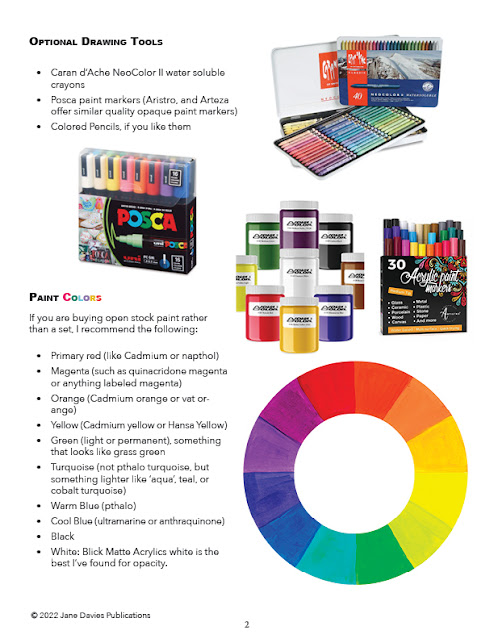
This is my Beginner's Supply List. Download it here.